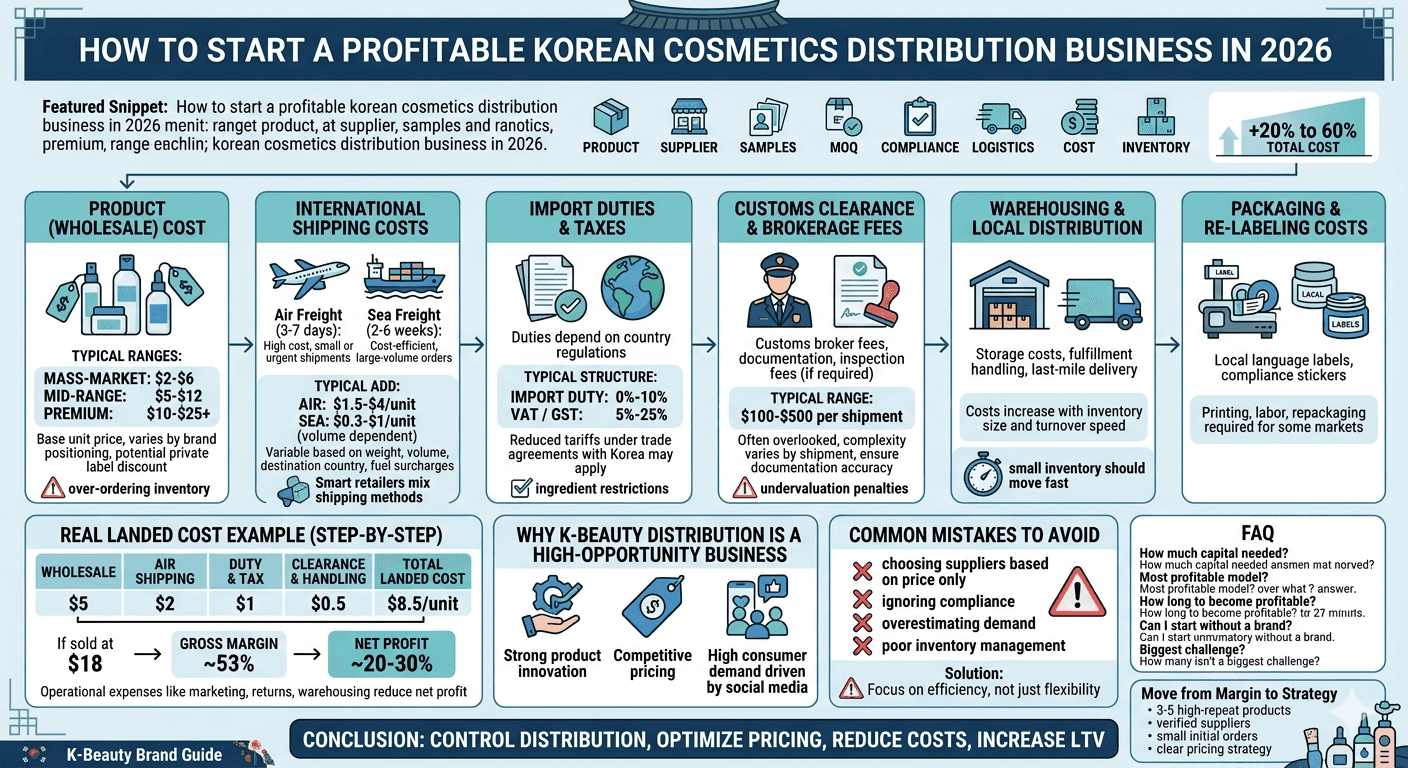
Private Label Korean Skincare: Costs, MOQ, and What Businesses Must Know
Private Label Korean Skincare: Costs, MOQ, and What Businesses Must Know
Market Trends | K-beauty trends 2026, Korean skincare export
Market Trends | K-beauty trends 2026, Korean skincare export
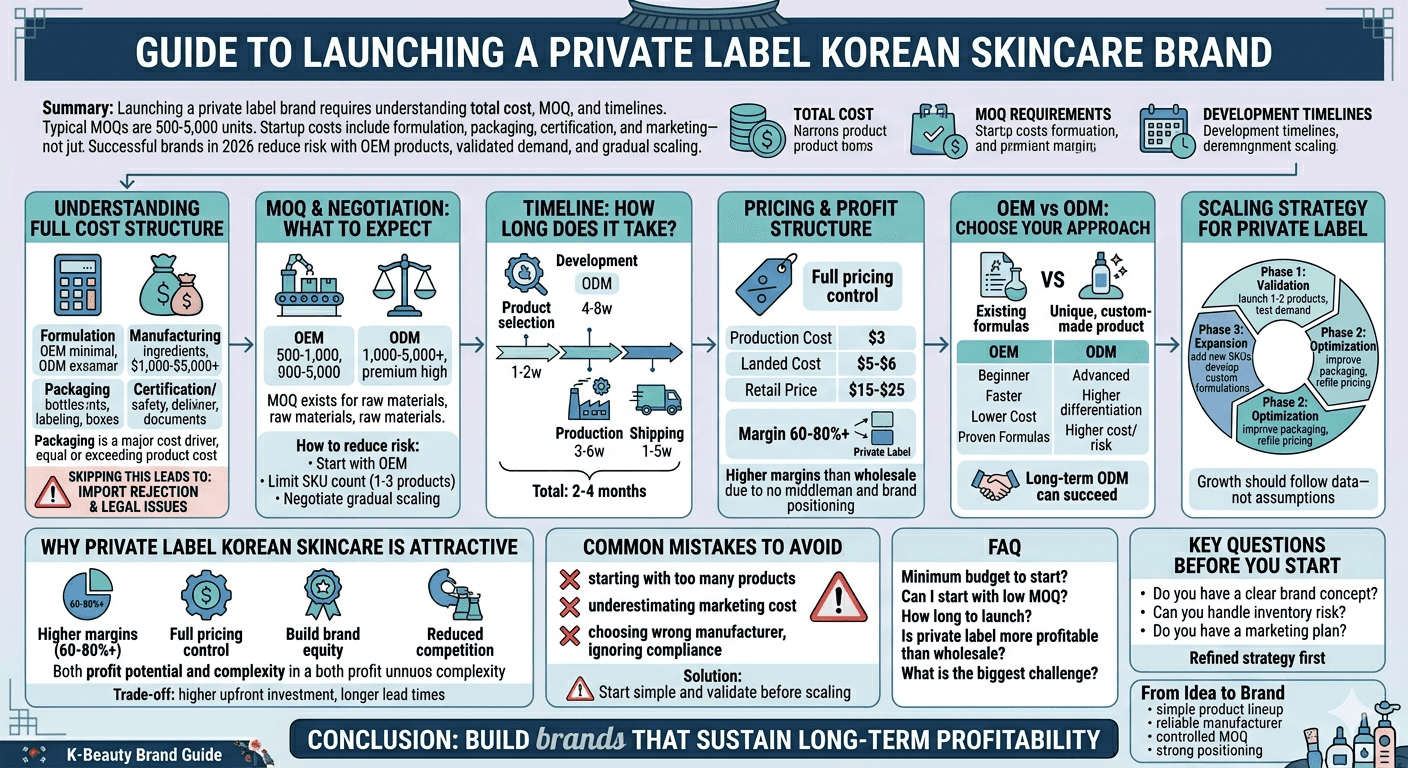
Launching a private label Korean skincare brand requires understanding total cost structure, MOQ requirements, and development timelines. Typical MOQs range from 500 to 5,000 units, while total startup costs include formulation, packaging, certification, and marketing—not just manufacturing. The most successful brands in 2026 reduce risk by starting with OEM-based products, validating demand, and scaling production gradually.
Launching a private label Korean skincare brand requires understanding total cost structure, MOQ requirements, and development timelines. Typical MOQs range from 500 to 5,000 units, while total startup costs include formulation, packaging, certification, and marketing—not just manufacturing. The most successful brands in 2026 reduce risk by starting with OEM-based products, validating demand, and scaling production gradually.
Why Private Label Korean Skincare Is Attractive in 2026
Private label is no longer just an option—it’s a strategic move toward higher margins and brand ownership.
What makes private label so appealing?
higher profit margins (60–80%+)
full control over pricing
ability to build long-term brand equity
reduced direct competition
But what’s the trade-off?
Question: If margins are higher, why doesn’t everyone do it?
Because it requires:
higher upfront investment
longer lead times
stronger execution in branding and marketing
👉 Insight
Private label increases both profit potential and complexity
Understanding the Full Cost Structure
Many businesses underestimate the true cost of private label.
1. Product Development Costs
Depending on approach:
OEM (existing formula): lower cost
ODM (custom formula): higher cost
Typical costs:
OEM: minimal formulation cost
ODM: $1,000–$5,000+ (development, testing)
2. Manufacturing Cost (Per Unit)
Depends on:
ingredients
product type
order quantity
Typical range:
$2–$8 per unit (basic skincare)
higher for premium formulations
3. Packaging Costs
Often underestimated.
Includes:
bottles / containers
labeling
boxes
design
Typical impact:
can equal or exceed product cost
👉 Insight
Packaging is a major cost driver
4. Certification and Compliance
Required for selling internationally.
Costs include:
safety testing
documentation
regulatory registration
👉 Skipping this step leads to:
import rejection
legal issues
5. Marketing and Branding Costs
The biggest cost long-term.
Includes:
branding design
website
ads
influencer marketing
👉 Insight
A great product without marketing will not sell
MOQ Explained: What to Expect
MOQ varies significantly based on supplier and customization level.
Typical MOQ ranges
OEM products: 500–1,000 units
ODM products: 1,000–5,000+ units
premium custom: even higher
Why MOQ exists
Question: Why can’t manufacturers offer low MOQ?
Because of:
production setup cost
raw material sourcing
packaging minimums
👉 Insight
MOQ is tied to manufacturing efficiency.
How to Reduce MOQ Risk
1. Start with OEM
use existing formulations
reduce development cost
lower MOQ requirement
2. Limit SKU Count
start with 1–3 products
avoid launching full product lines
3. Negotiate Gradual Scaling
Example:
first order: 500 units
second order: 1,000 units
price improves with scale
👉 Insight
MOQ should grow with demand—not assumptions
Timeline: How Long Does It Take?
Private label is not immediate.
Typical timeline
product selection: 1–2 weeks
development (if ODM): 4–8 weeks
production: 3–6 weeks
shipping: 1–5 weeks
👉 Total timeline: 2–4 months
Pricing and Profit Structure
Typical retail structure
production cost: $3
landed cost: $5–6
retail price: $15–25
👉 Margin: 60–80%+
Why margins are higher than wholesale
no middleman
full pricing control
brand positioning power
👉 Insight
Private label converts margin into brand equity
Common Mistakes in Private Label
1. Starting with too many products
→ high inventory risk
2. Underestimating marketing cost
→ low sales
3. Choosing the wrong manufacturer
→ quality issues
4. Ignoring compliance
→ import problems
👉 Solution
Start simple and validate before scaling.
OEM vs ODM: Which Should You Choose?
OEM (Recommended for beginners)
faster
lower cost
proven formulas
ODM
unique product
higher differentiation
higher cost and risk
Question: Which is more profitable?
👉 Short-term: OEM
👉 Long-term: ODM (if brand succeeds)
Scaling Strategy for Private Label
Phase 1: Validation
launch 1–2 products
test demand
collect feedback
Phase 2: Optimization
improve packaging
refine pricing
increase order volume
Phase 3: Expansion
add new SKUs
develop custom formulations
build brand identity
👉 Insight
Growth should follow data—not assumptions
FAQ
Q1. What is the minimum budget to start private label?
A. It varies, but costs include production, packaging, and marketing.
Q2. Can I start with low MOQ?
A. Limited options exist, but most manufacturers require 500+ units.
Q3. How long does it take to launch?
A. Typically 2–4 months depending on customization.
Q4. Is private label more profitable than wholesale?
A. Yes, but with higher risk and upfront investment.
Q5. What is the biggest challenge?
A. Marketing and brand building.
Key Questions Before You Start
Before launching, ask:
Do you have a clear brand concept?
Can you handle inventory risk?
Do you have a marketing plan?
If not, refine your strategy first.
From Idea to Brand
Private label is not just about selling products—it is about building a brand.
Start with:
simple product lineup
reliable manufacturer
controlled MOQ
strong positioning
Then scale based on real demand.
Businesses that succeed in private label don’t just chase margins—
they build brands that sustain long-term profitability.
Launching a private label Korean skincare brand requires understanding total cost structure, MOQ requirements, and development timelines. Typical MOQs range from 500 to 5,000 units, while total startup costs include formulation, packaging, certification, and marketing—not just manufacturing. The most successful brands in 2026 reduce risk by starting with OEM-based products, validating demand, and scaling production gradually.
Launching a private label Korean skincare brand requires understanding total cost structure, MOQ requirements, and development timelines. Typical MOQs range from 500 to 5,000 units, while total startup costs include formulation, packaging, certification, and marketing—not just manufacturing. The most successful brands in 2026 reduce risk by starting with OEM-based products, validating demand, and scaling production gradually.
Why Private Label Korean Skincare Is Attractive in 2026
Private label is no longer just an option—it’s a strategic move toward higher margins and brand ownership.
What makes private label so appealing?
higher profit margins (60–80%+)
full control over pricing
ability to build long-term brand equity
reduced direct competition
But what’s the trade-off?
Question: If margins are higher, why doesn’t everyone do it?
Because it requires:
higher upfront investment
longer lead times
stronger execution in branding and marketing
👉 Insight
Private label increases both profit potential and complexity
Understanding the Full Cost Structure
Many businesses underestimate the true cost of private label.
1. Product Development Costs
Depending on approach:
OEM (existing formula): lower cost
ODM (custom formula): higher cost
Typical costs:
OEM: minimal formulation cost
ODM: $1,000–$5,000+ (development, testing)
2. Manufacturing Cost (Per Unit)
Depends on:
ingredients
product type
order quantity
Typical range:
$2–$8 per unit (basic skincare)
higher for premium formulations
3. Packaging Costs
Often underestimated.
Includes:
bottles / containers
labeling
boxes
design
Typical impact:
can equal or exceed product cost
👉 Insight
Packaging is a major cost driver
4. Certification and Compliance
Required for selling internationally.
Costs include:
safety testing
documentation
regulatory registration
👉 Skipping this step leads to:
import rejection
legal issues
5. Marketing and Branding Costs
The biggest cost long-term.
Includes:
branding design
website
ads
influencer marketing
👉 Insight
A great product without marketing will not sell
MOQ Explained: What to Expect
MOQ varies significantly based on supplier and customization level.
Typical MOQ ranges
OEM products: 500–1,000 units
ODM products: 1,000–5,000+ units
premium custom: even higher
Why MOQ exists
Question: Why can’t manufacturers offer low MOQ?
Because of:
production setup cost
raw material sourcing
packaging minimums
👉 Insight
MOQ is tied to manufacturing efficiency.
How to Reduce MOQ Risk
1. Start with OEM
use existing formulations
reduce development cost
lower MOQ requirement
2. Limit SKU Count
start with 1–3 products
avoid launching full product lines
3. Negotiate Gradual Scaling
Example:
first order: 500 units
second order: 1,000 units
price improves with scale
👉 Insight
MOQ should grow with demand—not assumptions
Timeline: How Long Does It Take?
Private label is not immediate.
Typical timeline
product selection: 1–2 weeks
development (if ODM): 4–8 weeks
production: 3–6 weeks
shipping: 1–5 weeks
👉 Total timeline: 2–4 months
Pricing and Profit Structure
Typical retail structure
production cost: $3
landed cost: $5–6
retail price: $15–25
👉 Margin: 60–80%+
Why margins are higher than wholesale
no middleman
full pricing control
brand positioning power
👉 Insight
Private label converts margin into brand equity
Common Mistakes in Private Label
1. Starting with too many products
→ high inventory risk
2. Underestimating marketing cost
→ low sales
3. Choosing the wrong manufacturer
→ quality issues
4. Ignoring compliance
→ import problems
👉 Solution
Start simple and validate before scaling.
OEM vs ODM: Which Should You Choose?
OEM (Recommended for beginners)
faster
lower cost
proven formulas
ODM
unique product
higher differentiation
higher cost and risk
Question: Which is more profitable?
👉 Short-term: OEM
👉 Long-term: ODM (if brand succeeds)
Scaling Strategy for Private Label
Phase 1: Validation
launch 1–2 products
test demand
collect feedback
Phase 2: Optimization
improve packaging
refine pricing
increase order volume
Phase 3: Expansion
add new SKUs
develop custom formulations
build brand identity
👉 Insight
Growth should follow data—not assumptions
FAQ
Q1. What is the minimum budget to start private label?
A. It varies, but costs include production, packaging, and marketing.
Q2. Can I start with low MOQ?
A. Limited options exist, but most manufacturers require 500+ units.
Q3. How long does it take to launch?
A. Typically 2–4 months depending on customization.
Q4. Is private label more profitable than wholesale?
A. Yes, but with higher risk and upfront investment.
Q5. What is the biggest challenge?
A. Marketing and brand building.
Key Questions Before You Start
Before launching, ask:
Do you have a clear brand concept?
Can you handle inventory risk?
Do you have a marketing plan?
If not, refine your strategy first.
From Idea to Brand
Private label is not just about selling products—it is about building a brand.
Start with:
simple product lineup
reliable manufacturer
controlled MOQ
strong positioning
Then scale based on real demand.
Businesses that succeed in private label don’t just chase margins—
they build brands that sustain long-term profitability.